Monday, 4 October 2010

A Fowl Forecast


It is the end of the month and therefore checking the rain gauge time. I headed out with a foul forecast of incessant rain and wind in my ears, little knowing that it was also a fowl forecast. As I dropped down from Thornhill there were geese everywhere. They must have been pouring in over the last few days, a couple of flocks on stubble fields on the left and then on the south of the track to the Moss there were loads. I stopped to check them over and count them as sometimes an unusual goose can turn up in flocks like a barnacle or bean goose and sometimes you can pick out birds with neck markers put on by researchers to help find out migration movements. A quick scan revealed 30 greylags, 300 Canada geese and also 175 lesser black-backed gulls passing through on the way to Spain, and I was just starting to count the pinkies when a car came down the track and put them up, so at a guess maybe 500 of them. No neck rings or funny birds. Onto my list of things to do and the first stop the rain gauge. It was still dry but a dark grey wall was heading slowly my way. Back to the car park and then the rain came, good bog rain but uncomfortable as well. I chatted with some English visitors who had had a quick walk round and were heading back to their holiday cottage for another coffee and to re plan their day. Then I headed out onto the Moss to measure up and area for scrub cutting. Quickly everything became wet and I just had to keep my head down and splash my way round. All the time flock after flock of pinkies came over, either the same group had done 10 circuits of the Carse or there were 5000 pink feet in the stubble fields in and around Flanders. And not only had the geese come in, I flushed 8 snipe and 1 jack snipe who also use the Moss as a useful stopping off place as they head south as well. Back to the truck after 2 hours in the downpour and the rain had got through all water proofs (surely misnamed) and everything underneath was distinctly uncomfortable. I called it a day and headed back to the office after picking up a richly deserved Berits and Brown coffee (best coffee around). Oh and I know all you rain gauge buffs are asking what was the rain fall reading ? - 154 mm - a proper months rain at last and judging by the amount of rain that fell today the bloomin' thing is probably full again already!

Thursday, 30 September 2010

Different Hues


The recent cold nights and shorter days are having their annual impact. The Moss is changing colour. Actually the Moss is changing colour on a daily basis, it isn't just green in summer and brown in winter, the greens of June are very different from the greens of August and the browns of November are very different from the browns of February. I am sure that if shown a photo taken at Flanders regular visitors could guess within a few weeks what month it was taken in. The cotton grass looking like its on fire, the birches are speckled yellow, brown and green and the heather is going that muted purple of gone over blossoms. With a bit of sun there are still plenty of insects to study from 5 minutes lying on the boardwalk. These changing hues are always best seen on wilder sites so the contrast between the Moss and the surrounding intensive farmland is even greater at this time of year. So why not go hue spotting ?

Tuesday, 28 September 2010

Glorious Day


I am writing this in the cold and damp dark of Monday evening but Sunday (only yesterday but seems long ago) was a glorious day. I did a "Meet the Wardens" event on Sunday which is really just me and a few props on top of the tower chatting to people whether they like it or not and answering questions about Flanders. Being a blue sky, bright sun and warm sort of a day there were loads of people out and I had nearly 4 hours of continuous chatting. And lots of interesting people with good questions. To help things along we picked out some red deer in the plantation on the telescope, a red kite came over the Moss and there were loads of black darter dragonflies around which are always good entertainment. One of the most interesting comments came from a local Thornhill person who noted the calming effect that walking round the boardwalk has on people, old and young alike. Certainly even with groups of children going round there are rarely many screams and shouts. So is it the special atmosphere of the Moss or the ancient landscape or the disconnection from the rest of the world that you get when you pass from the car park through the trees out on to the Moss ?
Anyone out there do with thoughts on this ?

Monday, 27 September 2010

Natural birch control


The nibblers are off, or most of them anyway. Since early July 40 Shetland sheep of the Scottish Wildlife Trust have been helping with our scrub control by grazing an 8 ha area of Flanders. They have done an excellent job, setting to their task with dedication and over the 3 month period have nibbled off a lot of birch. But one years grazing isn't enough to kill all the birch so this is something that needs to be done every year. And what are the benefits ? Well in keeping the vegetation down and the birch under control it allows the sphagnum to develop and a good sphagnum carpet keeps the Moss wet.
But it isn't as simple of just pushing the sheep out into the field and leaving them to get on with it. The sheep are regularly checked to make sure they are fit and healthy, by the SWT shepherd Laura but also by SNH staff and volunteers Ann and Roy. Counting 40 sheep might sound easy as well but these are small sheep that like nothing better that to hide in bushes and behind trees or sometimes go through fences just for the hell of it. So we are really grateful for Roy and Ann for all their time put in staggering round the moss, trying to find the right number of sheep and check they are still upright (the sheep not Roy or Ann). It is only with their effort that the grazing has been possible. So if anyone else is out there and fancies helping out with sheep counting contact me and we could use your help next year.
And maybe next year the Scottish Wildlife Trust flock might have some Flanders Moss lamb to sell and then you could eat for bog conservation, that is my favourites way of habitat management.

Friday, 24 September 2010

Tesco's bag and dfferent hats


I had time to kill in between finishing tasks and meeting Laura the shepherd. I could sit in the truck and use the phone and write stuff or I could get out on the Moss. The incessant rain of the last few days was easing and though it was wet, dull and grey and there probably wouldn't be much to see I headed out to look where we have a work party next month.
After 2 days of hard rain the Moss was wet, very wet, wet enough for most treads to be into 3-4" of water. This dampness brings out the rich colours making them almost glow in the dim, moist air. I splashed alongside the plantation and suddenly, looking like a gang of naughty boys 20 red deer hinds and calves crashed over the fence and bounced off to the middle of the moss. It is close to the rut and I expect that they are starting to gather though I saw no sign of any stags. As I watched the deer through the binoculars what looked like a Tesco's bag on the wind floated by in the distance - a male hen harrier hunting along the edge of the High Moss Pow. All around me meadow pipits pee-peed, are they birds that bred here or migrants passing through or northern birds arriving for the winter - another mystery unanswered. Ravens rasped and coughed behind me and overhead a few house martins weaved their way south. By then my ears were working full-time and I heard a snipe making its squelching call above, a party of skylarks barrelled by burbling as they went and all around small parties of geese clamoured, pinkies, greylags and even a party of honking Canadas.
Time to head back to the truck and meet Laura to talk about the end of this years grazing and possibilities for next year - sheep hat on, bird hat off.

Monday, 20 September 2010

European Visitors


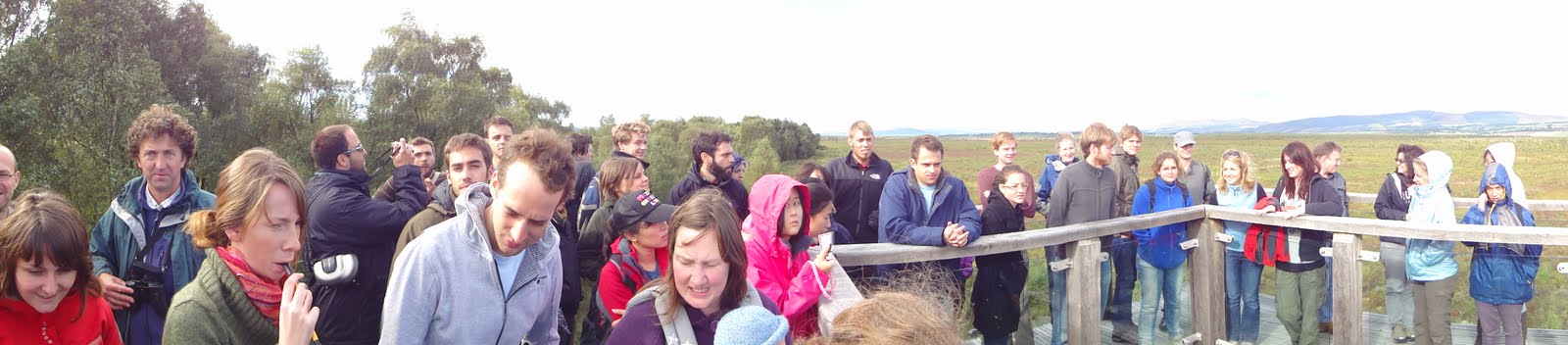
An interesting day at Flanders on Thursday. We hosted a mixed group of European nature reserve managers to look at the work we are doing at Flanders and how climate change may impact on it. There were professionals from all over the place, from the Mediterranean to Scandinavia, England, Wales and Scotland and even someone from Australia. As you can imagine the discussion were varied and information went both ways. Advice and options were offered to us on methods of scrub control, especially where it might not involved using herbicides while there was a lot of interest from the group in our recycled plastic boardwalk and the impact of the viewing tower. These events can be immensely useful as they get you to look at your site with new eyes, get you to question and justify again the work that you are doing the methods involved and give you confirmation where you have got things right. It will take a few days of thinking about them for the full impact of all the questions to take effect.

What was also great was that Thursday was the first day of the pinkies arriving at the Moss. Apparently last week pink footed geese had been building up in Iceland until the weather changed the the wind was blowing in the right direction to speed them south. Since then the geese have been pouring south and reached Flanders Thursday morning. Their amazing flight took them hundreds of miles across the seas and for some of them they will have been making this journey for the 10 th time or more. Listen out for their "wink, wink " call as they move around the Carse filling up on the stubble fields for the next stage of their journey south.

Thanks to Udo all the way from Australia for the first 2 photos in this posting.

Friday, 10 September 2010

Take a sniff and squint


Well you turn your back for a few moments and another season creeps up on you before you know it. If you take a walk around the boardwalk at Flanders the signs of autumn are there to see. The obvious ones are the brightly coloured toadstools that daily change their appearances and magically their locations. The first few brightly coloured leaves that are starting to float down, mainly from the birch which is never hesitant to shed its leaves, the sphagnum, freshly hydrated by the torrential rains of earlier in the week are as bright as they can be and the bog cotton is just starting to take on to turn to red looking like flames licking the each of the pools. But it is also in the smell of the place. Take a sniff and you will get that cool fragrant damp tang that says to me compost and heather. And a squint will show you that the light takes on a very different intensity as the sun doesn't reach as far in the sky and the moisture is the air softens the rays and your shadows change shape with the season. Enjoy.