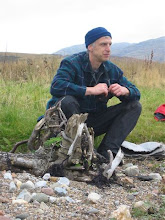
Flanders is a great place for barn owls as their is loads to eat in the form of juicy voles found in the long grass around the Moss edges. But it isn't perfect as there aren't any nesting places. So to help them we have put up 3 plastic barrels (recycling !) with entrance holes cut in trees on the edge of the Moss. These need checking each year for use and this year I had a lovely surprise when I took the top off one. A face full of flies, a honking smells and a hiss like a steam engine and there were FOUR fat, fluffy white chicks. We hope to ring them (put a numbered metal ring on their legs) before they leave the nest. It is great to see them doing so well as the previous hard winter w
Monday, 28 June 2010
Honking barrels
Barn owls are magically birds but when they are young they really do look horrible. And their nest smells. Below are chicks in a nesting box we have on Flanders Moss.
Flanders is a great place for barn owls as their is loads to eat in the form of juicy voles found in the long grass around the Moss edges. But it isn't perfect as there aren't any nesting places. So to help them we have put up 3 plastic barrels (recycling !) with entrance holes cut in trees on the edge of the Moss. These need checking each year for use and this year I had a lovely surprise when I took the top off one. A face full of flies, a honking smells and a hiss like a steam engine and there were FOUR fat, fluffy white chicks. We hope to ring them (put a numbered metal ring on their legs) before they leave the nest. It is great to see them doing so well as the previous hard winter w
inter would have been especially hard for them.

Flanders is a great place for barn owls as their is loads to eat in the form of juicy voles found in the long grass around the Moss edges. But it isn't perfect as there aren't any nesting places. So to help them we have put up 3 plastic barrels (recycling !) with entrance holes cut in trees on the edge of the Moss. These need checking each year for use and this year I had a lovely surprise when I took the top off one. A face full of flies, a honking smells and a hiss like a steam engine and there were FOUR fat, fluffy white chicks. We hope to ring them (put a numbered metal ring on their legs) before they leave the nest. It is great to see them doing so well as the previous hard winter w
Thursday, 24 June 2010
Moth Magic 2
It is time to set up the moth trap again. This involves driving round Flanders the night before and filling up the genny with petrol and then setting the light running in the dusk. It was a perfect evening but this makes it perfect for midges as well. By the time I had finished I was coated in midges and had given enough blood to run a hospital. At least I knew it was working as when I drove back home I could see the bright light shining across the Moss.
So the next morning I met the local moth expert John Knowler on the edge of the Moss and we headed down to empty the trap and see what we had.
And it was great the trap was full and there were loads of moths of the vegetation around the trap. The downside was that there were loads of midges as well, the is often a puff of them when you first open up the trap. For the next 1.5 hours we systematically worked our way through the moths counting, commenting, putting a name and just admiring them. Some of the gems included several beautiful grey light knot grass, a huge female northern eggar, several delicate grass waves and for me most beautiful of all 4 silvery arches. These moths had only been recorded a few times in the area before and never more than one per trap and we caught 4, all freshly hatched. These moths have a silvery sheen that has hints of pink and green that make then look something like a delicate sweet wrapper. I was thankful to have John along as when we were searching through the trap twice we came across small dull looking moths that tried to flitter away. I would have let them go but John quickly caught them in pots. After a lot of umming and arhing he identified them as a shaded pug and a round-winged muslin moth. Well it turns out that shaded pug has only been caught 3 times before in this area (lowland area of central Scotland), the last time being in 1987. The round-winged muslin hasn't been caught in this area since 1977. So both of them very special species even if they don't look at smart.
The names of some of the moths we caught are fantastic beautiful brocade, clouded bordered brindle, common lutestring, scorched wing, true lovers knot and the coxcomb prominant.
There is plenty of the season left for more trapping and this year is proving to be a cracker.
Wednesday, 23 June 2010
Butterflies that don't fly
A different day a different species. Counting again but this time orchids. All this counting what is the point ? Well it gives us measurable information about the changes of these key plants and animals.
So I headed out to the west part of Flanders with local orchid counter Roy Sexton to find the patch of greeny white lesser butterfly orchid and pinky fragrant orchids. The lesser butterfly orchids (or LBOs) are a flower that is declining fast across the UK and so a lot of effort is being put into monitoring the colonies left to find out more about them. 2 years ago we had a record year of about 40 flower spikes, last year only 10 or so. So we were unsure what we would find. First to appear the fragrant orchids and i set off to count them. The fragrant orchid gets its name from, yes you guessed it, its nice smell, some of the orchids smell at lot worse, like the early purple orchid that smell of tom cat wee, it is lucky it didn't get its name from its smell. 79 fragrant flowering spikes, excellent. Meanwhile Roy was counting the LBOs - 87 spikes !! A Flanders record. Orchids are funny things and it can be difficult to tell why they suddenly do so well but one reason maybe the good grazing levels where the sheep and cattle are removed to allow the orchids to flower.
Other gems while orchid searching include roe deer bouncing away after dozing in the sun, bright orange small pearl-bordered fritillary butterflies bombing past and a small meadow pipits nest that had an unusually large paler brown egg amongst the dark brown pipit eggs. I suspect that it might be a cuckoo egg but I will have to revisit and see if a week or twos time.

Other gems while orchid searching include roe deer bouncing away after dozing in the sun, bright orange small pearl-bordered fritillary butterflies bombing past and a small meadow pipits nest that had an unusually large paler brown egg amongst the dark brown pipit eggs. I suspect that it might be a cuckoo egg but I will have to revisit and see if a week or twos time.
Tuesday, 22 June 2010
Counting birds again
It was warm and muggy and I started off trying to separate towering skylarks and plunging pipits along the grassy edge of the Moss. Working my way onto the dome the cottongrass twinkled in the heat haze like stars on a frosty night and suddenly there was a different sort of tweeting. There sitting in the grass was a young reed bunting nearly left the nest - proof of breeding, tick box. Ears ready and receiving I kept moving, further on a "peep chuck" signalled a whinchat, finally pinned down to the top of a bush, further still the scratchy phrases of 2 whinchat males singing against each other across an expanse of bog. A cascading torrent of willow warblers song contrasted with the chaffinches clatter. A brief reeling of a grasshopper warbler, a trilling blast from a wren and a few heat smothered flutety notes from a blackbird all made it into the notebook. At the lochan a wall of willow warblers needed sorting and in all the noise I nearly missed the funny hiccuping bit at the ned of a tree pipit song flight. In the distance a pheasant squawked, overhead and then landing close by a couple of redpolls churred. So at the end of the set 2 hours I stumble blinking off the moss, shake my head and re-enter the real world remembering to close down my ears so as not to be deafened by the first loud sound and look forward to the next count.
And in between the birds the Moss had other offerings, large heath butterflies bobbling across the moss looking for nectar, common heath, 4-dotted footman and grass wave moths zig zagging the bog, a huge rattling golden-ringed dragonfly and much less welcome and proving that it isn't all perfect out there the first of the years clegs slipping their needle mouth parts under the skin.
Monday, 21 June 2010
Lie Down, Look Up
I had just written this following post when I saw that Helen and David (see comment on previous post) were ahead of me and
already doing it, well here goes anyway.
Well it was a nice day, warm and dry and the boardwalk looked quite comfortable so I thought why not have a lie down and see what Flanders looked from down there. When you get to know a site really well sometimes it is good to try to look at it from a different perspective or with new eyes. This was my corporate justification for lying on the boardwalk on a sunny day for 15 mins, just in case my line manager is reading this - if he isn't then it was just a nice thing to do.
Being low level meant that nodding cotton grass and the sky was about all you could see so immediately it felt like the volume was turned up in my ears. The Moss became alive with busy insects and birds. A great buzzing came from all around as flies, beetles and bees criss crossed above me. The bird song got louder with meadow pipit display songs all around, the tinkling and trilling of skylarks and willow warblers filling the background and piercing it all the was the excited common gulls. Spread across the sky the cirrus clouds confirmed the fine weather and then a dot slowly moved across the cloud wall paper resolving itself as a sparrowhawk given away by the flap, flap circles it flew. Swooping around it feeding on the aerial plankton of insects the swallows from surround farms and swifts from nearby villages. And then a buzzard stirred things up as it sedately soared across, sending the gulls in a frenzy. And it between all of this there was time to appreciate the cloud shapes that many people don't give a second glance to.
So why not take a few minutes to lie down and look when you are next at Flanders, but I hope the Labradors don't find you !
Tuesday, 15 June 2010
Forth Valley Outreach Class Go Bogging


Forth Valley outreach class which is part of Access and Progression held in Callander visited Flanders Moss on Thursday 3rd June and met up with David Pickett. It was part of their course Citizenship and Environmental Studies.Here are some of the students comments.
Craig
The weather was great and so were the views.
Jimmy
I liked the sphagnum moss and saw lots of dragonflies.
Shona
We saw damsel flies they lay their eggs in the water.
Kay
I enjoyed looking through my binoculars and a lizard went between my feet.
Jenny
It was a beautiful day hot and sunny and we learned so much having David to show us round.
George
I enjoyed the visit and seeing the insects in the water.
Lesley Anne
David showed us some antlers and we sat on the board walk.
Saturday, 12 June 2010
Gardeners - do something for a bog and compost. !

It is a shock when you hear experts get in wrong. I was at Gardening Scotland (Scotland's biggest gardening show) last weekend and was horrified with what I heard from a well known media garden expert. At a wildlife gardening debate that he chaired he was heard to say that "harvesting peat was sustainable only thin layer of peat was taken off the top of the bog and bogs grow 1 mm a year anyway ". So basically he said was it was fine to cut peat to use in gardens as the bogs grow back. Unfortunately this is very wrong. Flanders Moss took 7000 years to grow to what it is now but in the 1970's a 100 ha part of Flanders was prepared for peat "harvesting" by scraping the layer of vegetation off and putting in parallel drainage ditches. SNH managed to step in a buy out the peat planning permissions to prevent peat being actually dug and save the bog but not before this area was left dry, dusty and with no bog plants or animals on it at all. Since then we have been damming ditches to rewet the area and restore living bog and this has brought back sphagnum to parts of it but after all this time some areas still are only bare peat and heather with no sphagnum . It may take 100's of years before it is covered with a complete living bog skin.
So quite simply peat "harvesting" (even this word is wrong as it implies an annually produced crop) in not sustainable. Any bog where it happens is at best irreparably damaged and at worst killed (above is a picture of a bog undergoing "harvesting", see no green at all). The simple fact is that if you use peat then it has come from a bog somewhere that is being destroyed so if you want to save wonderful plants and animals like the ones that you see in this blog then don't listened to the so called gardening experts that say it is alright to use peat but make your own by home composting. Before the 2 world war virtually no-one used peat in their gardens but they still managed to create wonderful growing areas so it is possible to grow big veg and beautiful flowers not at the cost of bog wildlife.
Subscribe to:
Posts (Atom)