Wednesday, 31 March 2010

Follow The Signs


Flanders Moss National Nature Reserve has just become been officially put on the tourist map this week when Stirling Council put up some new brown tourist signs. It has been a bit of a performance to get the signs up but now the reserve is sign posted from the B873 Aberfoyle road in Thornhill and the A811 from the Kippen roundabout. It wasn't easy to find the reserve before but now tourists and day visitors will have no problem getting to the car park.

Why do we want brown signs ? Well Scottish Natural Heritage has invested a lot of money in the infrastructure of the reserve so that people can visit it, enjoy it, be inspired by it, learn about why it is special and find out what they can do to save this bog and others around the world. So it is important that people can find it easily. There are a large number of visitors to go along the main roads to the north and south of Flanders to and from Stirling and the Loch Lomond National Park and we would like to attract in some of them. Hopefully the surrounding villages will also benefit from these visitors when people go to them for refreshments and services.

The one possible problem is if we attract too many visitors that start to affect the reserve. But if this happens then we easily remove the brown signs to reduce the visitors again.

Monday, 29 March 2010

Spring before the snow


This is what I have mostly been seeing on the Moss today:
  • Skylarks singing,
  • Meadow pipits dispalying
  • Frogs spawn everywhere
  • Cotton grass flowers just starting to come out
  • Curlews bubbling away in the fields
  • Common gulls on the pools by the boardwalk
Good for the soul and all good reasons to visit Flanders Moss NNR boardwalk over Easter.

Tuesday, 23 March 2010

Parachute Birds


Last night was the last hen harrier count for the winter and other counts since Christmas there were no hen harriers seen. It has been a poor winter for hen harriers at Flanders Moss but we will have to wait and see when all the national count results are collated if this just applies to Flanders or applies across the country.

Despite the lack of raptors it was still a joy standing on the tower watching the day end on the Moss. I did watch with trepidation the onward march of a huge black cloud coming in from the south west bring with it a curtain of rain that crept across the moss and soaked me 5 minutes before the end. But there is always something to see and hear and for me the highlight was a small group of meadow pipits pee peeing across the bog. And then one of them flew up and started singing its display song while spreading its wings and floating gently back to the ground with its wings held still and out. This was the first display flight of what will be many by what the children call the parachute bird.
Thanks to Lorne Gill, the SNH photographer for the photo of the meadow pipit below.


Monday, 22 March 2010

Toad Policemen


The warmer wet weather is starting to encourage some action out on the moss. On Friday I headed out onto the Moss and passed an old sheet of corrugated iron. Now turning over corrugated iron sheets is a much underrated pastime as you never know what you might find. Sometimes it is an ants nest, sometimes a vole or two and I live in hope if finding an adder under one though that was never going to happen this time of year. This time there blinking in the day light was a toad. Almost certainly it had in the last few days come out of a hibernation, about a month later than many years. As soon as it has got itself together and had a feed of slugs and earthworms it will head off to its spawning grounds for a few weeks of mating activity. On Flanders this might be the lochan or smaller puddles, ditches and pools. Someone the other day told me that toads can live for up to 40 years if lucky. I rather like the idea of an ancient toad patrolling its same part of the moss for years on end cleaning up the neighbourhood of slugs. "Right what's going on around here then, oi you young feller-me-slug you're knicked,.. slurp. " Every garden should have a toad on slug patrol so why not make a toad home such as a pile of stones or bricks of a sheet of iron and let them clean up your neighbourhood ?
Further onto the edge of the Moss I found 2 rather sluggish frogs, also just out of hibernation and probably heading off to the lochan. From the photos you can easily see the difference, the toad with the lumpy (warty ) skin and horizontal pupil (top 2 photos), the frog (bottom 2 photos) with the smooth, damper looking skin and the rounder pupil. And to help in identification the toad often walks but the frog always hops. All across Central Scotland over the next few weeks frogs and toads are on the move, especially on warmer, wet nights so please be careful at night when driving and try to avoid them as they cross the road.


Saturday, 20 March 2010

Pretty Gulls


There are lots of gulls about. So what ? Well actually they are worth paying a little attention as at this time of year there is a lot happening in the gull world. At Flanders Moss the other day the field next to the Moss was being ploughed and there were several hundred gulls feeding on the freshly turned soil. After a bit of a watch I found 3 types of gulls, common, black-headed and lesser black-backed gulls moving around the field. All these gulls have different annual life strategies but had congregated at the crossroads that is the Carse of Stirling.
Take the black-headed gull. These gulls breed and winter in Scotland in large numbers, about 43000 pairs breed here but 160 000 winter, the wintering birds being local birds and also from all over including England, Iceland and Scandinavia. These birds by Flanders are on the move to their breeding grounds, stopping off on the way for a feed. Back in the 1950's a huge colony of 10-12000 pairs used to nest on Flanders Moss out by the lochan and it was to these birds that people would walk out onto the Moss to collect their eggs. No-one really knows why the colony on the Moss disappeared but it was unlikely to be down to just the egg harvesting.
The common gulls are not namely correctly as they aren't really common and are in fact declining. About 80 000 birds winter in Scotland but in spring up to 200 000 birds move through Scotland from where they winter down south. These birds at Flanders Moss are probably moving through Scotland and onto Scandinavia and Norway especially. Later in April we may see the pair that nested near to the boardwalk at Flanders return. Maybe this is the start of a big colony like the black-headed gulls ?

As for the lesser black-backed gulls, they are fair weather gulls. Apart from a very few birds they all winter in Spain and southern Europe and return to Scotland to breed in March/April. These birds also used to breed on Flanders Moss, the colony growing to at least 4000 pairs before disappearing in the mid-1980s. One theory for their disappearance was the closing down on the small local landfill sites such as the one at Buchlyvie, their food supplies, and the opening of the further away Polmaise dump. Tellingly lesser black-backs now nest on the roofs of industrial buildings in Stirling, nearer to their food sources.

So next time you spot some gulls have a go at trying to identify them and have a think about how far they might have travelled to get where you are seeing them. A bird id book will help you put a name to the gulls, it is far better than me putting photos on the blog.

Thursday, 18 March 2010

Low Flying Witches


It is that time of year that birds are starting to think about nesting and if you are at the car park at Flanders you could be mistaken in thinking that one of the birch trees on the edge of the Moss is full of birds nests. But what you are seeing are Witches Brooms. Not birds nests but birch disease. These masses of twigs are caused by a fungus called Taphrina betulina that enters into the tree and upsets the plant hormones (chemicals) that control the growth of the tree. The exact arrangement of twigs and buds in all trees are controlled by these chemicals, each tree has different chemicals which give the tree its distinctive arrangements of twigs and branches. This fungus messes with these chemicals and encourages a burst of twig growing. Why ? So that the fungus can then feed on the increase of plant material. The tree itself isn't actually harmed and can have these "birds nests " on it for years.

If the twig growth all goes in one direction then it can look a bit like a birch or witches broom and was probably used for sweeping where possible. The other theory on their formation is that they are formed when witches fly over the tree. In which case we have a witch flyway over the moss as there are so many.

So if you are in the car park before the leaves are back on the trees check out the witches brooms but keep an eye for low fliers overhead as well.


Tuesday, 16 March 2010

Twice in a day


I got trained on yesterday and it was fantastic. Finally the weather is turning. Glorious as the cold dry weather has been yesterday the wind blew hard from the west bringing heavy showers that the dry moss desperately needs. Many winters have been continually wet and windy so the return of the rumble hiss of the wind was like an old friend met again, the rain welcome even though it barely put the dust down. But that bit of moisture brought colour to the ground and at the risk of sounding like a politician there is evidence of green shoots of recovery in the blasted browns of the bog plants. Later on in the day more evidence of something starting to happen, the first plop of a frog diving in one of the pools and some frogspawn.
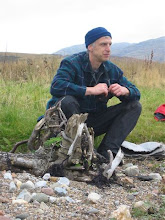
I was clearing more junk off the Moss, the remains of another pheasant pen that the past users just left for others to clear up. While doing this I met Mr Miller, a neighbouring farmer who grazes land right next to the Moss. He has been working next to the Moss for over 20 years but has never been out on it and never really wanted to. I hear this quite often and I can understand it, if you are working long hours to manage land productively why go out onto the completely unproductive land next door. Luckily some people are keen to see the Moss and as I was handing out the latest Flanders Moss NNR newsletter a number of people said how much they enjoyed visiting the place. One of the ladies in Berits and Brown said that she had gone down to the Moss for the first time on Sunday afternoon and she enjoyed it so much her second visit was only a few hours later.
By the way if you want a newsletter just contact the SNH Stirling office on 01786 450362 and leave your name and address and we can send you one.