Friday, 24 September 2010

Tesco's bag and dfferent hats


I had time to kill in between finishing tasks and meeting Laura the shepherd. I could sit in the truck and use the phone and write stuff or I could get out on the Moss. The incessant rain of the last few days was easing and though it was wet, dull and grey and there probably wouldn't be much to see I headed out to look where we have a work party next month.
After 2 days of hard rain the Moss was wet, very wet, wet enough for most treads to be into 3-4" of water. This dampness brings out the rich colours making them almost glow in the dim, moist air. I splashed alongside the plantation and suddenly, looking like a gang of naughty boys 20 red deer hinds and calves crashed over the fence and bounced off to the middle of the moss. It is close to the rut and I expect that they are starting to gather though I saw no sign of any stags. As I watched the deer through the binoculars what looked like a Tesco's bag on the wind floated by in the distance - a male hen harrier hunting along the edge of the High Moss Pow. All around me meadow pipits pee-peed, are they birds that bred here or migrants passing through or northern birds arriving for the winter - another mystery unanswered. Ravens rasped and coughed behind me and overhead a few house martins weaved their way south. By then my ears were working full-time and I heard a snipe making its squelching call above, a party of skylarks barrelled by burbling as they went and all around small parties of geese clamoured, pinkies, greylags and even a party of honking Canadas.
Time to head back to the truck and meet Laura to talk about the end of this years grazing and possibilities for next year - sheep hat on, bird hat off.

Monday, 20 September 2010

European Visitors


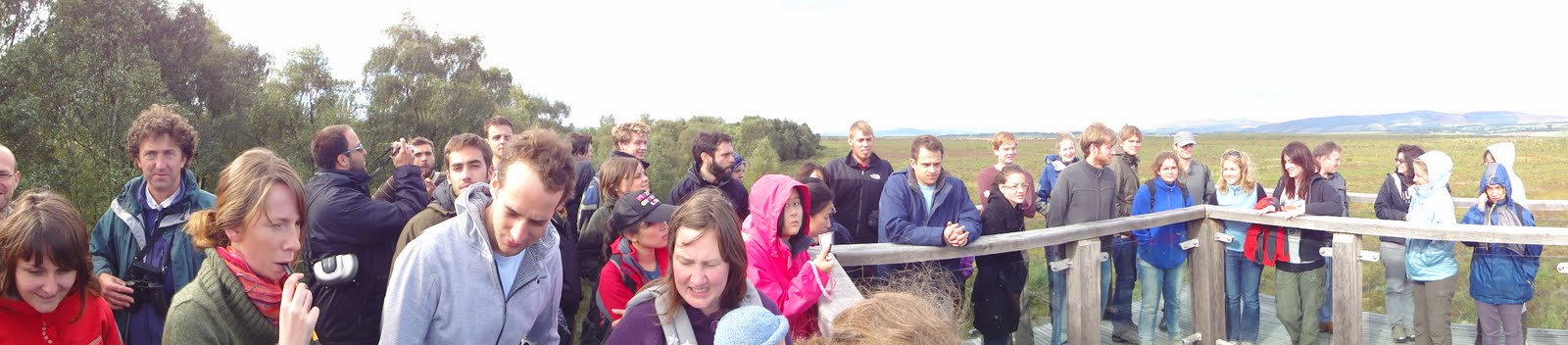
An interesting day at Flanders on Thursday. We hosted a mixed group of European nature reserve managers to look at the work we are doing at Flanders and how climate change may impact on it. There were professionals from all over the place, from the Mediterranean to Scandinavia, England, Wales and Scotland and even someone from Australia. As you can imagine the discussion were varied and information went both ways. Advice and options were offered to us on methods of scrub control, especially where it might not involved using herbicides while there was a lot of interest from the group in our recycled plastic boardwalk and the impact of the viewing tower. These events can be immensely useful as they get you to look at your site with new eyes, get you to question and justify again the work that you are doing the methods involved and give you confirmation where you have got things right. It will take a few days of thinking about them for the full impact of all the questions to take effect.

What was also great was that Thursday was the first day of the pinkies arriving at the Moss. Apparently last week pink footed geese had been building up in Iceland until the weather changed the the wind was blowing in the right direction to speed them south. Since then the geese have been pouring south and reached Flanders Thursday morning. Their amazing flight took them hundreds of miles across the seas and for some of them they will have been making this journey for the 10 th time or more. Listen out for their "wink, wink " call as they move around the Carse filling up on the stubble fields for the next stage of their journey south.

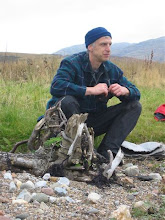
Thanks to Udo all the way from Australia for the first 2 photos in this posting.

Friday, 10 September 2010

Take a sniff and squint


Well you turn your back for a few moments and another season creeps up on you before you know it. If you take a walk around the boardwalk at Flanders the signs of autumn are there to see. The obvious ones are the brightly coloured toadstools that daily change their appearances and magically their locations. The first few brightly coloured leaves that are starting to float down, mainly from the birch which is never hesitant to shed its leaves, the sphagnum, freshly hydrated by the torrential rains of earlier in the week are as bright as they can be and the bog cotton is just starting to take on to turn to red looking like flames licking the each of the pools. But it is also in the smell of the place. Take a sniff and you will get that cool fragrant damp tang that says to me compost and heather. And a squint will show you that the light takes on a very different intensity as the sun doesn't reach as far in the sky and the moisture is the air softens the rays and your shadows change shape with the season. Enjoy.

Monday, 30 August 2010

Stepping on an adder


I trod on an adder on Wednesday, not the one in the picture but a smart, freshly shed skin little female. Both of us were a bit surprised, and luckily it was the side of my foot on the soft bog surface so neither of us suffered. But it did make me jump a bit, the heart beat a bit faster and i was glad of my wellies. I tend to wear these all year round not just to keep a bit drier but also as snake protection. After staring a me for a bit in surprise she just slithered away into the tussocks into the adder sized network of tunnels under the surface. It was at the end of a fantastic day out on the Moss taking the water table measurements. It feels like we are on the cusp of season change. It was cool to start off with and then warmed up to become bright and breezy. There were lingering signs of summer with the willow warblers singing half snatches of songs and swallows, sand and house martins filling up on the Moss abundant insects to fortify themselves for their epic journey south. One of the Moss creepy crawlies made itself felt as I went round, a huge spider had hitched a ride on my back and dropped off when I stopped for a drink, making my pack at least a pound or two lighter. See it on my pencil. But autumn in close at hand and nothing showed this more than there sitting on top of the first water monitoring station was a beautiful 2ND year male hen harrier. It had a brownish tinge to its back feathers showing that it hasn't yet got its full spotless grey breeding plumage. They spend the winter on the Moss after breeding further north so this one was early. I am not ready to think about winter yet, especially after the last one so am trying not to take this as a sign of a hard winter to come but just an individual with a wanderlust and desire to get places early.

Thursday, 26 August 2010

Not So Moth Magic


It has been a great year for moths so far and with a bit of effort we have added a few species to the Flanders list. But there are times when opening up the moth trap just doesn't quite reach the peak of excitement and the other day was one of those times. It had looked a potentially good night but the temperature dropped and it turned out to be probably a bit too cool. Arriving at the trap with Prof John Knowler, the resident Flanders moth expert we immediately found virtually no moths on the vegetation around the trap...not a good sign. We then started into the trap and found a gently scattering of moths but no mass burst of fluttering. A few large ears (a moth not a personal comment) and a chevron were new for the year and a smart late ingrailled clay as shown looked good. But in the end there were only 35 moths of 15 species which was a bit disappointing. It was good thing that Prof John was along as when we got to the bottom of the trap there was a little group of very small moths that I took for micros. Now micro moths and small and very difficult to tell apart. It usually takes a real expert and a bit of genitalia dissection to identify them (the micros not the experts) so I tend to just leave them alone. But John grunted a surprised grunt a picked one up for a better look. "Ahhhh, a marsh oblique barred" he said. This had me scrabbling for my book and it turns out that these moths were actually macros (big moths), there were 10 in all, and are a national scarce moth recorded in fewer than 100 10 km squares across the UK and this was the largest single catch that John had caught. As you can see from the photos it may not be stunning but it was by far the best species of the trap so sometimes good things come in small packages.

Monday, 23 August 2010

Here be bog dragons - is that it ?


Well last week we were out looking for bog dragons on Flanders... or the northern emerald dragonfly to be precise. This dragonfly is a north species and a bit of a mystery to boot. It is found mainly in north Scotland and was found on Flanders Moss 3 years ago by our redoubtable volunteer Prof John Knowler. He found 1 recently emerged individual while out looking for moths and this has proved to be the most southerly record in the UK of what is quite a scarce species. So after more searching with no luck we invited down the Scottish dragonfly recorder Pat Batty to help us see if we could find out a bit more about this creature. Now the best way to confirm the presence of this insect is not to look for the adults but the larvae. These creatures live for up to 4 years in wet, peaty pools that are completely filled with sphagnum. This makes hunting for them with the usual nets very difficult so a quick raid on the kitchen produced a plastic colander that is ideal for sieving the sphagnum to find these little larva. According to Pat you can tell the difference from other dragonfly larva because they are hairy and have a round bum, probably best to say no more on this point.
Anyway within 10 mins. of starting to look we found 1 larva, so excited we set off with enthusiasm sieving sphagnum in likely pools for the rest of the day. But never found another larvae for the rest of the day despite sampling likely habitats across the Moss.
So the mystery is not only how do these strange creatures survive in thick sphagnum soup, what do they eat and how do they catch it but also what makes them choose specific squidgy bits to live in ? So next year the search will continue to find out more about these dragons on Flanders with trusty colander in hand, and guess what the wife is getting for her birthday ?

Friday, 20 August 2010

The battle of the trees


When meeting people out at Flanders Moss we gets lots of questions about all the birch trees that are growing up around the boardwalk and the area to the west. People generally know that too many trees aren't good for the bog as they dry it out by sucking water out of the peat and intercepte the rain with their foliage so that it never reaches the bog surface. So they want to know what we are doing about them all. Well things are happening though it is not always obvious. One thing that is going on is in the Plantation, the 40 ha area to the west of the boardwalk over looked by the viewing tower. The conifer trees were removed back in 1997/8 and since then ditches have been blocked to make it wetter but the birch has still started to spread. In the long term we aim to get grazing going in this area to control the birch regrowth but in the meantime we are working with a fellow government agency Forest Research to trial methods of applying herbicide to kill the birch. Plots have been marked out with posts and herbicide applied to the small birch using different techniques to see which one works best and which one has least effect on the bog vegetation. You can see the cleared squares from the viewing tower.
Over the last couple of weeks Forest Research guys have been sweating it out in showers of rain and clouds of midges to fix markers in the plots and carry out studies on the effects of the herbicide.
So these plots are really just a little skirmish against the birch but should help us plan our tactics to escalate the conflict to a battle as part of an overall war. Cor, makes me sound like a war correspondent ! Will keep you posted from the front line.